
| What's New? | Support this website! |
Amazing Rock Art: What does it mean? Humans are thought to have arrived in North America about 23,000 years ago, and then arrived in Great Basin about 13,000 years ago. In that time, the native peoples who lived around Las Vegas hundreds and thousands of years ago created some amazing rock art, which they refer to as Rock Stories. It is thought that many of the rock stories were related to religious practices or annual rituals, but the true meanings are lost to history. For example, today we might look at a petroglyph and say that clearly it is a bighorn sheep. However, what does it mean? Maybe it is drawn during a pre-hunting ritual to bring good luck and a feast for the hungry tribe. On the other hand, maybe it was just the gang sign for the Bighorn Clan telling the Raven Clan to stay away. Today we have no way to choose between these two possible explanations, so we can only stand in awe at the skill and imagination of the people who lived here long ago.
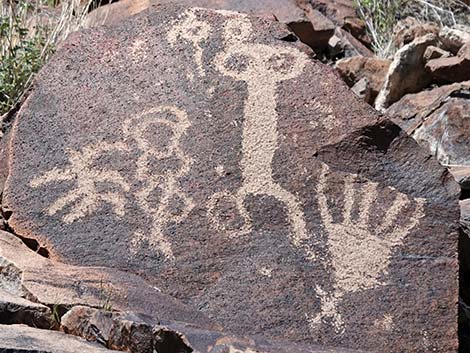
Two Basic Types: Petroglyphs and Pictographs. Petroglyphs are images pecked or carved into the rock surface, usually by removing the dark surface coating (desert varnish) to reveal lighter-colored underlying rock. Pictographs are images made by painting on the rocks using plant and mineral pigments. Occasionally, the two types are found together, and sometime petroglyphs are painted over making them show up better.
Archeological Sites. There are many rock art sites around southern Nevada. All rock art is an irreplaceable treasure, and because modern humans have a long history of damaging the artwork, experts consider many sites too sensitive to make the locations generally available. In that spirit, I only describe rock art at publicly known sites. I know of many sites, and other people know of far more, but presented here are excellent examples that have been made public by government agencies. To see pictures of other rock art around Las Vegas, visit Southern Nevada Rock Art & Nevada Drone Archaeology, which is in transition. Bob has dedicated his life to documenting rock art sites around Las Vegas and making his photos available to researchers and the public -- just don't ask him for locations!
New or Old: How to tell? Modern humans have added their marks to the rocks, often damaging existing rock art. Usually modern marks are obviously new, but sometimes it can be hard to tell. Look for the quality of the work and the regrowth of desert varnish. More
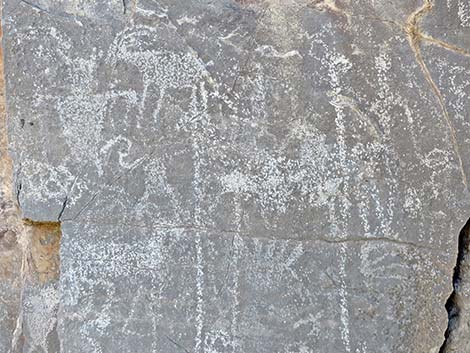 |
Arrow Canyon Wilderness Area There are several interesting rock art sites in the Arrow Canyon Wilderness Area, but none are available for public disclosure. To see these panels, hikers must spend some time out and about in the wilderness. Rock art in this area is interesting because most are on limestone where there is no desert varnish patina to peck off. Others are carved into relatively soft mudstone deposits. |
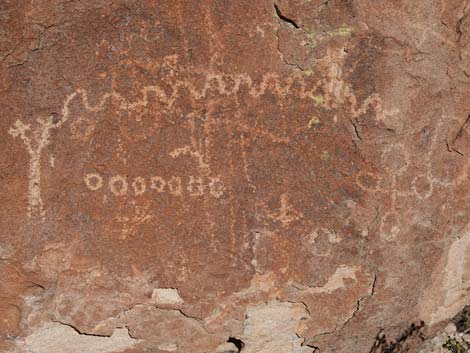 |
Basin and Range National Monument In the upper Pahranagat Valley (about 110 miles north of Las Vegas), six BLM rock art sites were popularized by the Lincoln County Department of Tourism with the publication of a 55-page brochure about the area (including GPS data). The sites are: Mt. Irish, Shooting Gallery, and White River Narrows. The sites include extensive boulder-field panels and cliff-face panels. Access roads can be rough (Shooting Gallery is 4WD), but visitors in sedans can drive up to some wondrous petroglyphs. The underlying rock here is consolidated volcanic ash (mostly ash-flow welded tuff rhyolite). |
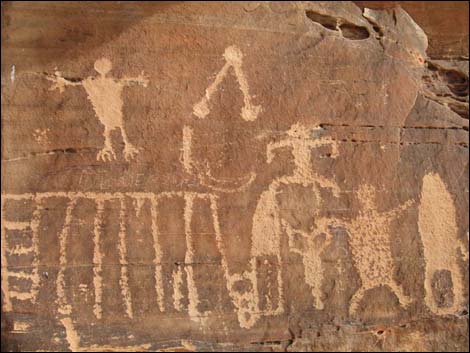 |
Gold Butte Region Gold Butte Region is a wild and remote region with high peaks, low valleys, grand views, lots of history, mixed up geology, and huge solitude. It might be easier to just say that Gold Butte is an adventure. Parts of this remarkable area are covered with petroglyphs. Some of the easiest sites to visit are in the Falling Man Site and Whitney Pocket areas. The small Mud Wash Panel is easy to get to in a 2WD-HC vehicle. Other rock art sites are hidden away here and here at the end of hiking adventures. The underlying rock here is red and white sandstone. |
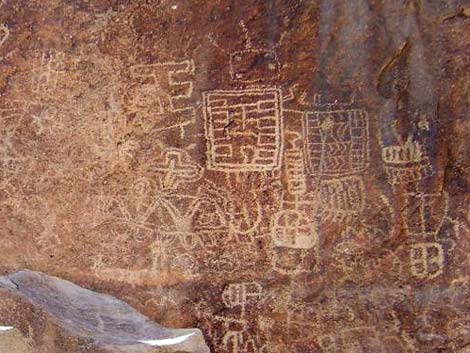 |
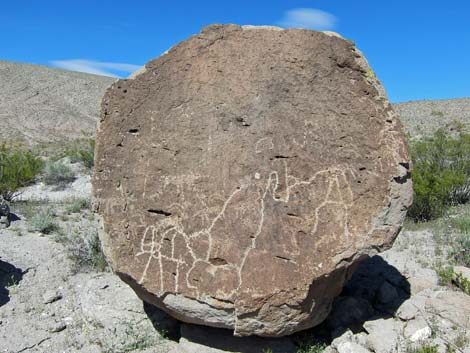
Lake Mead National Recreation Area There are some truly amazing petroglyph sites at Lake Mead. Two such sites are Grapevine Canyon (near Laughlin) and Keyhole Canyon south of Boulder City. The hike to Grapevine Canyon is about 0.3 miles. The underlying rock at these two sites is granite. |
 |
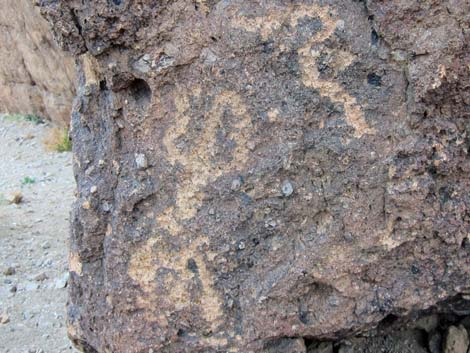
Lincoln County Archeological Sites (Alamo, Hiko, and Caliente areas) In the upper Pahranagat Valley (about 110 miles north of Las Vegas), six BLM rock art sites were advertised by the Lincoln County Department of Tourism with the publication of a 55-page brochure about the area (including GPS data). Three sites are inside Basin and Range National Monument (Mt. Irish, Shooting Gallery, and White River Narrows), and remaining sites are Ash Springs, Crystal Wash Entrance and Crystal Wash Main, and Rainbow Canyon (Rainbow-1, Rainbow-2, Rainbow-3, Rainbow-4). These sites include extensive boulder-field panels and cliff-face panels. Access roads can be rough (Shooting Gallery is 4WD), but visitors in sedans can drive up to some wondrous petroglyphs. Another interesting site is the Crystal Wash Shepard Camp. The underlying rock here is consolidated volcanic ash (mostly ash-flow welded tuff rhyolite). There are also some nice sites in the Delamar Valley. |
 |
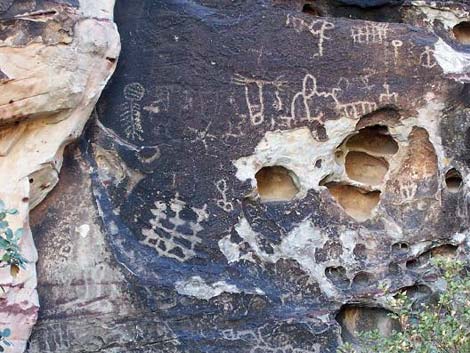
Mojave National Preserve There are several interesting rock art sites in Mojave National Preserve. One such site is located along the Rings Loop Trail near the Hole-in-the-Wall Visitor Center. The artwork is mostly representational and very old, but there is one newer bighorn glyph. |
 |
Red Rocks Canyon National Conservation Area There are a number of very nice petroglyph sites at Red Rocks. A few good sites are located in Willow Springs Canyon. There are nice petroglyphs on the west side of the canyon on Petroglyph Wall, and there are nice pictographs (hand paintings) on the east side of the canyon along the Willow Springs Loop Trail. There are good examples of agave roasting-pits in the area too. The trail to the petroglyphs is about 0.1 miles long, and the pictographs are a 30-second walk on a paved trail east of the small outhouse in the picnic area. The Willow Springs Loop Trail passed additional rock art sites. Calico Basin also has some nice rock art along the new boardwalk. The underlying rock here is red and white sandstone. |
 |
Sloan Canyon National Conservation Area Sloan Canyon, proper, is located on the south edge of the Las Vegas Valley, just south of Henderson. The Sloan Canyon Archeological District is one of the most important cultural sites in Southern Nevada with some 300 petroglyph panels and 1,700 individual petroglyphs that were created by native cultures from the Archaic to historic era. Roads are almost nonexistent, and trails are few, but during winter, full-sun hikes at Sloan Canyon NCA can be warm and delightful. |
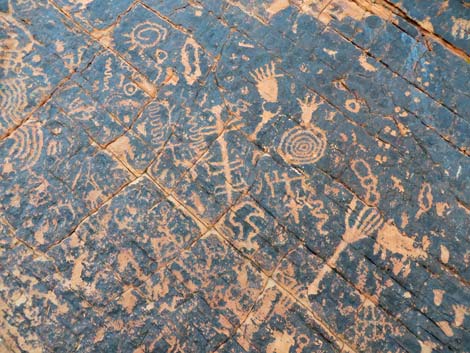 |
Valley of Fire State Park As with other areas around Las Vegas, there are some great petroglyph sites at Valley of Fire. Atlatl Rock and Mouse's Tank are excellent sites with easy access. The paved road runs up to the base of Atlatl Rock, and the petroglyphs begin a short walk down the Mouse's Tank Trail. The underlying rock here is dark red sandstone. |
Happy Hiking! All distances, elevations, and other facts are approximate.
 ; Last updated 240323
| Guide Service | Glossary | Copyright, Conditions, Disclaimer | Home |