
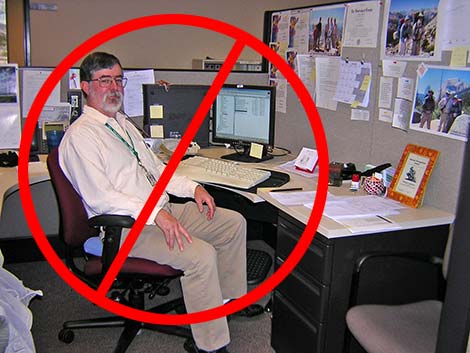
 Free at last; free at last; thank God almighty, I'm free at last (with all due respect to Dr. King). I abandoned my corporate cubicle in 2006. |
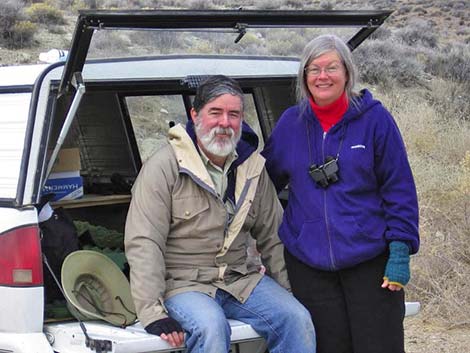 Camping in Death Valley. We are off to a wonderful early semi-retirement! |
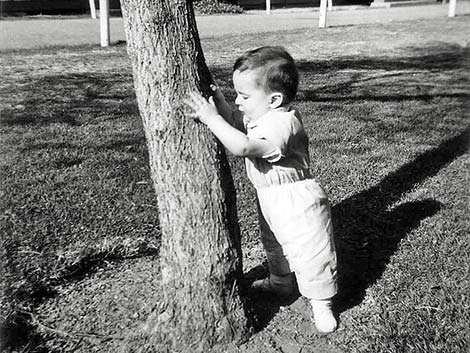 I was a tree-hugger from the beginning Los Angeles, CA, USC Campus Family Housing |
I’m an outdoors person. I come by it honestly -- Daniel Boone is in my blood. My father grew up on the flatlands of the Texas Gulf Coast, but the urge for the mountains struck him early when he went on a Boy Scout trip to west Texas. After a week in the west Texas hills, the flat lands of the Gulf Coast were never the same for him. Daniel Boone was in his blood too. My parents met as undergrads in college. They married and went to southern California for Grad School in part to be near the mountains (Yosemite) and deserts (especially Death Valley and Joshua Tree). I got started not much later, and they took me camping in Death Valley before I was born. After I was born, Mom still talks about a night in Yosemite sleeping on a picnic table with dad defending the food cache from the bears. I'm not sure if we lost our food that night, but the bears got it on other camping trips. We were of modest means, so family vacations were camping trips. Three kids in diapers, and another later on, didn't stop them from taking us camping. We just loaded up the family van and headed out. We usually took one long trip (2 weeks) and several short trips each year. |
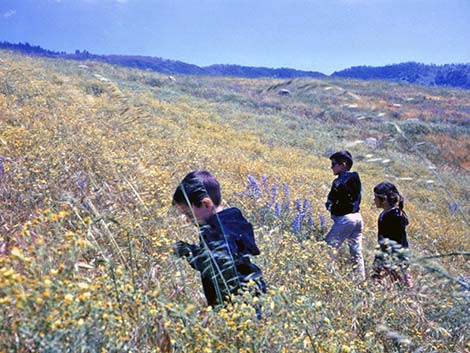 Early interest in botany (Antelope Valley, CA; 1965) |
Our long family trips alternated between family reunion trips to Texas (Dad's side of the family) or Florida (Mom's parents retired to south Florida) one year, and trips to wild places around the western U.S. the next year. We drove and camped on the Texas trips, but took the train or bus to Florida. On one Texas trip, we drove back home through central Mexico and I got my first taste of the Central American jungle. I was fascinated by the snakes and lizards, and among other things, I recall catching a long, thin vine snake that was crossing a road (bit me several times). Later, I performed perhaps my first wildlife rescue when I caught a monster green iguana in the empty swimming pool at our motel. I took the lizard back to the jungle and set it free. |
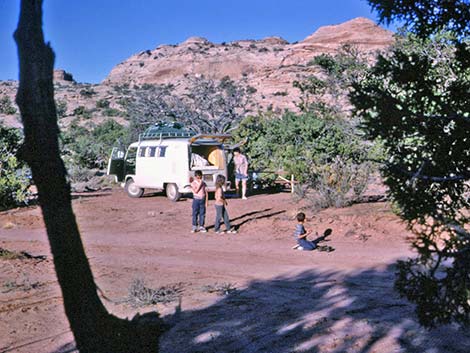 Family camping trip (Canyonlands NP, UT; 1965) |
On other Texas trips, we visited the Arizona-Sonora Desert Museum, and I recall sitting out front and watching lizards soaking up the sun in the original chuckwalla exhibit, and then sitting out back and watching heat lighting on a clear, sunny day. We also visited Carlsbad Caverns where I was fascinated by the underground life and geology. Little did they know, but my parents were grooming my fascination with deep, dark holes in the ground. |
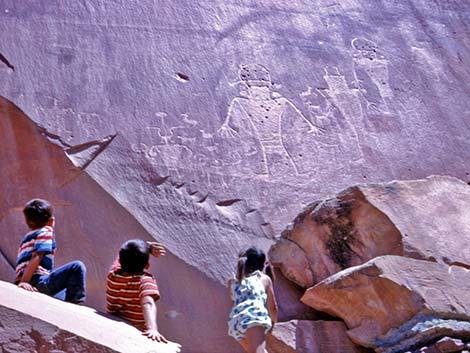 Early interest in rock art (Utah; 1965) |
One year we camped in Big Bend National Park and swam the Rio Grand River into Mexico to stake our claim to the moniker "wet-backs." On those Sonoran Desert trips, I recall hearing hundreds of toads calling from a roadside ditch, seeing thousands of frogs migrating across the highway while snakes, foxes, and owls sucked up as many as they could. Dad tried to drive around the migrating masses, but there were so many that we ended up just avoiding the big animals. On train trips to Florida, the southern swamps passing by the window fascinated me, and I stood on the platform between cars for hours hanging out the open window to smell the swamps and moss-covered trees while watching the water in hopes of seeing a big-old alligator. |
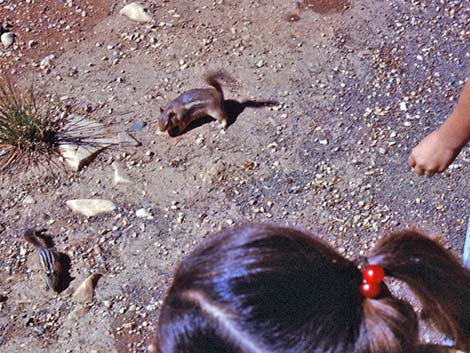 Early interest in rodents |
On the Gulf Coast, my cousins and I would head out on our own swimming from island to island and hiking around and through the sand hills and mangrove islands. I don't recall that we found much, but seeing stingrays take off just in front of us and worrying about getting swept out to sea sticks in my mind. When I was still young, I made the train and bus trip to Florida alone. I don't remember the circumstances of why I went alone, but my parents always trained me to be independent. One thing I remember was getting off the train in some southern city (perhaps New Orleans?) and walking out of the train station into the city looking for a grocery store to buy apples (no more low-end train food for me!). I had grown up in southern California with lots of cultural diversity, but as a white kid carrying a duffel bag, I sure felt out of place and unwelcome; I guess I've always felt out of place in big cities. |
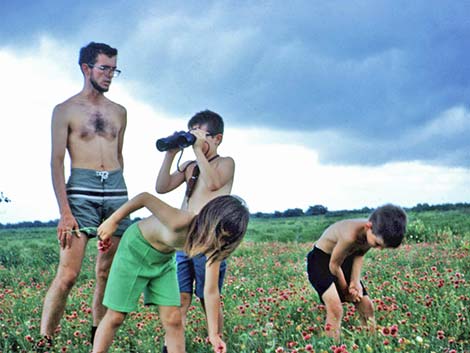 Early attempt at bird watching (South Texas; 1966) |
The short trips usually were 2- and 3-day weekend camp-outs to the mountains, beaches, and deserts around southern California, but we often spent spring break and parts of our summer vacations camping for a week or so. Joshua Tree and Anza Borrego were favorite winter destinations, and the beach at San Clemente was a favorite spring-break destination. Mom often took us during spring break because dad had to work. |
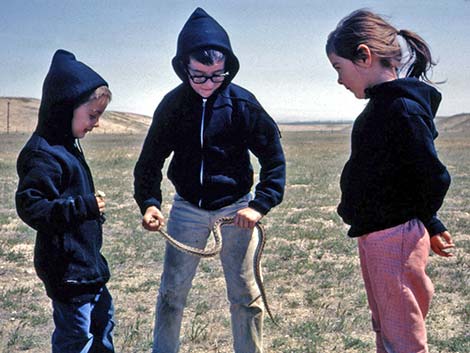 Seven years old and already harassing the wildlife (Antelope Valley, CA; 1965) |
Even with all of this activity, Dad still found time to backpack with his buddies from work. He got his first 35 mm camera in 1965 and started doing slideshows of his trips. Watching his slides, I longed to join him backpacking, and dad took me out for the first time when I was 10. We hiked into Little Lakes Basin at the head Rock Creek on the east side of the Sierra Nevada Mountains for a couple of days. I was a big-time fisherman back then, but when I went out fishing, I got turned around and couldn't find my way back to camp. After hiking in circles a couple of times in the fading evening light, I realized that I might be in for a long, cold night. I stopped walking, thought about the situation, looked at the lay of the land, figured out how to find camp, and walked right in. Daniel Boone was in my blood, and I was hooked. |
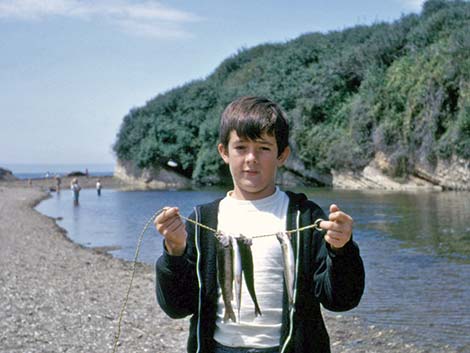 Catch of the morning (Montana de Oro, CA; 1967) |
Dad then began taking me out with his backpacking buddies. We did Mt. Russell (over 14,000 feet) in the Sierras when I was 13. I went on three backpacking trips when I was 14, not counting Boy Scout trips. When I was 15, I picked up my backpack and hitchhiked alone to the Canadian border, but they wouldn't let me in; I probably would have gone all the way to Alaska. At 16, a buddy and I hoisted 60-pound backpacks and did 30 days on the John Muir Trail (ending in Yosemite Valley) in the high Sierras without resupplies. At 17, another buddy and I did the John Muir Trail again a little farther south (King's Canyon to Mammoth). At 18, I was the mule hauling 80-pound packs on week-long backpacking trips with the family. |
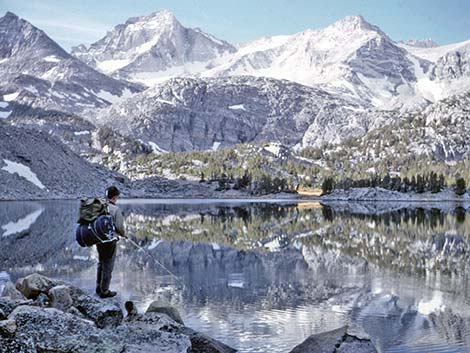 First backpack (Sierra Nevada Mountains, Rock Creek, CA; 1967) |
As a kid, I climbed on every rock I could find, but by the time I was 16, my parents said "no more" until I learned to use ropes. That was all it took, and we were off to Tuolumne Meadows for the Yosemite basic rock climbing school. A day or two later I did my first technical rock climb when some friendly lady climbers lowered a belay line to me from the tip of Cathedral Peak. I tied in using a bowline-on-a-coil and never looked back; little did they know where their kindness would lead. During my junior and senior years in high school, I climbed every chance I got. My buddies and I would leave town on Friday after school and drive to Joshua Tree or one of the other southern California climbing areas. We would climb all day Saturday and Sunday, and drive home Sunday night. |
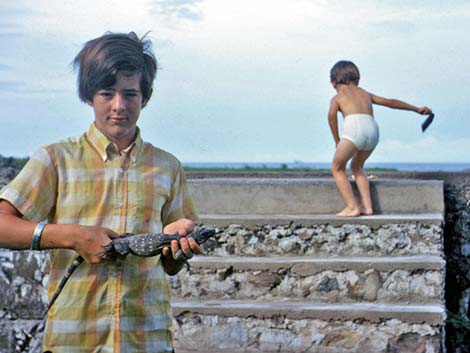 In my mind, this monster lizard is still 3-4 feet long Coastal Central Mexico (1970) |
After graduating from Fullerton Union High School in 1975, I was a climbing bum for a few years. I worked when I had to, but I spent most of my time in Yosemite Valley during the spring and Joshua Tree during the winter, and then visited places like Tuolumne Meadows, Big Rock, Tahquitz, the high Sierra for a change of scenery. I even spent time climbing at Red Rocks (Las Vegas) helping to open up the area in the days before guidebooks and crowds. It is fun to go back to these places now and see climbs where I lead the first ascent or even named rock formations (e.g., the Great Burrito in Hidden Valley, Joshua Tree National Park). When I read the guide books, however, I see that most of my first ascents were lost to history. |
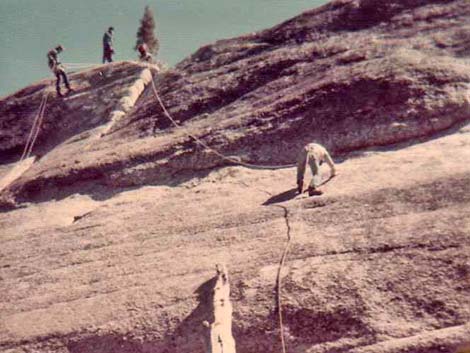 Yosemite Climbing School (Tuolumne Meadows; 1973) |
Life was sweet, but I had to make a living. I worked the first two summers out of high school with the US Forest Service in the woods of northern Idaho thinning trees, cruising timber, burning clearcuts, and fighting forest fires. I even did a stint working on a helicopter logging operation during my second fall up there. Even living in the woods, I found time for backpacking, fishing, and rafting the Clearwater River. Wednesday nights, however, were spent dancing and drinking beer in the nearest cowboy bar (I guess for that country, saying "cowboy bar" is redundant). We had a good time. I loved working in the woods, but by working up there I realized that I didn't want to spend my life plundering the forest, I wanted to spend my life protecting the forest: it was a park ranger's life for me. Rangering required college, so off I went. I got rejected from Humboldt State University on the northern California coast, so I went to the adjacent community college (College of the Redwoods). I ran out of rent money, so I spent much of the winter and spring living in my truck (camping) on the edge of Humboldt Bay. Being mostly broke, I went crabbing, clamming, and fishing for dinner after classes. |
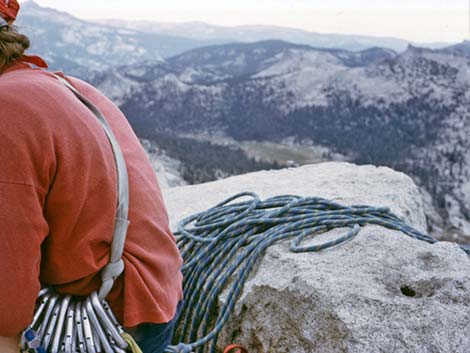 First technical rock climb: Cathedral Peak Yosemite National Park, CA (1973) |
I learned to interact with computers that year by playing computer games. It is surprising to see where that lead, although I don't play computer games these days. I also recall a writing class where I didn't get along with the professor because I wrote essays on subjects that interested me, and my politics were a bit more liberal than his. I also took a technical writing class. We had to do an experiment and write it up. I killed several bean plants by over fertilizing them, but what the heck -- it was my first science experiment and the start of many more. I managed to get a work-study job washing petri dishes in the microbiology lab. It was disgusting, but it put a few extra dollars in my pocket. |
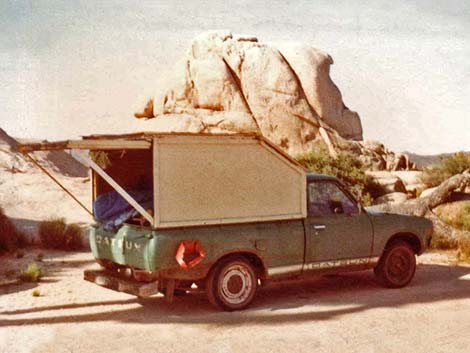 My first live-in camper (Joshua Tree NP; 1974) |
With summer coming on and the few dollars in my pocket saved from not paying rent burning a hole in my pocket, wanderlust set in hard. A buddy and I hoisted heavy packs and followed our thumbs north to Alaska. It's hard to believe they let me into Canada this time -- we even declared that we had a rifle -- but they didn't even search us (too bad we burned our stash on the American side of the border). After a few days on the Alcan Highway, we made it to Dawson City, Northwest Territories, and met two French Canadians getting ready to set sail down the Yukon River. We asked for a ride, and and hour later started off on ten days heading down the big river. We visited backwoods homesteads where people were raising children, ate black bear stew, played with huskies (winter transportation), and spent a lot of time watching the wilderness and wildlife go by. We camped on sandbars hoping to avoid grizzly bears. Bears always were in the back of our minds, and we saw tracks, but we didn't see any great bears along the river. |
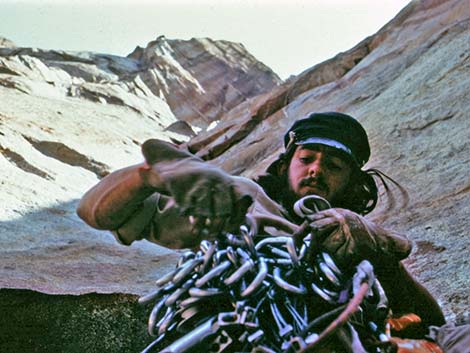 Leading a pitch on the Leaning Tower (day 2 of 3) (Yosemite NP, CA; 1976) |
We got off at Circle, Alaska, and after restocking in Fairbanks, we headed north again and spent two weeks hiking across the tundra hunting and fishing, panning for gold, standing literally nose-to-nose with a bull moose (I'm still not sure which of us was more startled to see the other), seeing the midnight sun and 24-hours of sunlight, zillions of mosquitoes -- I'd been in wilderness before, but never in such wildness. The tundra is tough country to hike across, so hard in fact that we found it easier to hike in the streams rather than on "dry" land. Fortunately it was warm, and we didn't need to worry about wet and frozen feet. We found old homesteads with decomposing log cabins and sunken grave sites. A family lived, dreamed, and die here long ago in a wildness that I couldn't even imagine, but longed for nonetheless. |
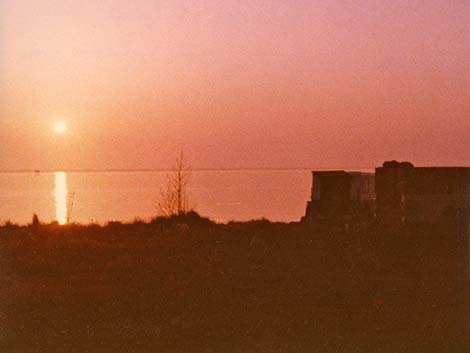 Home on Humboldt Bay (Fields Landing, CA; 1977) |
We eventually headed south to Denali and did a long trek on the northwest side of the peak. Denali was amazing for wildlife, fast moving water, and grand open scenery. ... hunting and fishing across Alaska, I would have made old Dan proud. With fall coming on, I left my friend in Alaska and headed back to college in 29 Palms, California, the headquarters of Joshua Tree National Park. I lived and climbed in the park, took classes, taught technical rock rescue to the rangers, and ended up getting a job with the Park Service. Before my Park Service career was over, I had worked as a seasonal ranger at Lake Mead National Recreation Area (don't ask about this, I'll just deny it), Grand Canyon National Park, Sequoia National Park, and Joshua Tree National Park. |
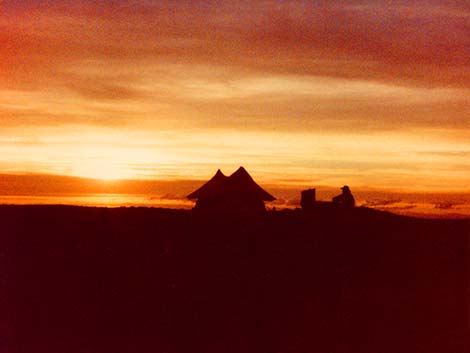 Midnight sun deep in central Alaska (Summer 1977) |
During one of the technical rock rescue classes I was teaching at Joshua Tree, I had a student who was a botanist volunteering for the park collecting Bighorn Sheep scat. She took the scat apart to identify the plants the sheep were eating -- a woman after my own heart. Pathetic, I know -- I ended up marrying one of my students. Our honeymoon was a 3-month camping and winter birding trip across the southern border of the U.S. We birded from San Diego to Brownsville, TX, then up around the Gulf Coast to the Florida Keys and the Dry Tortugas, and out to Puerto Rico. We ticked off more than 400 species of birds. |
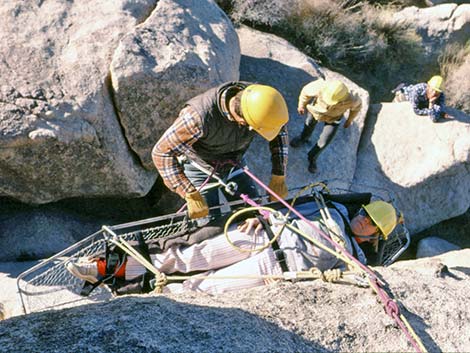 Teaching technical rock rescue (Joshua Tree, CA) |
We decided to go back to college together, and this time I was accepted at Humboldt State University in northern California. When we first moved to college, we lived for most of two years in rural McKinleyville in a converted, detached garage with the landlord family living in the main house. We liked rural life, but it was difficult living out there. We had one neighbor with a cow that lived in the front yard and stayed on the front porch during rain storms -- the cow eventually got sick and sprayed feces all over the porch and halfway up the front door (they never cleaned it off). |
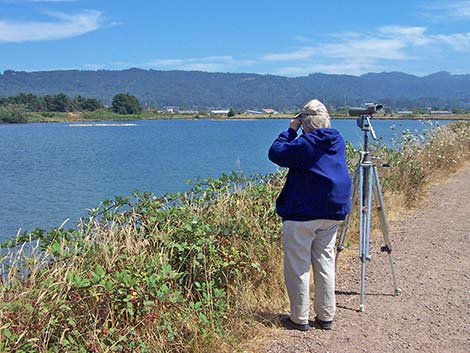 Birding the Arcata Marsh (Humboldt County, CA) |
The landlord was poor and probably faced losing the property to taxes, so they started growing marijuana in the backyard to make money, and we got nervous. One afternoon while driving home, we saw a police officer parked at our local gas station and stopped to ask about the legal consequences of our living situation: Jim: "Officer, we have a friend living in a situation ..." (I ran through a story about a landlord started growing marijuana in the backyard) Officer: "If I were you, I would move out." He saw right through my story, and we moved to town. |
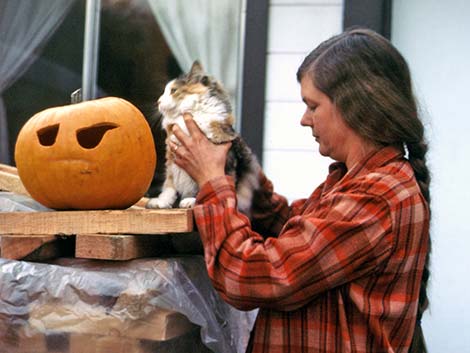 Liz and "P" at home (McKinleyville, CA; ca. 1984) |
We spent four years in college and worked as rangers in Sequoia National Park during the summers. I earned a wildlife degree, and Liz earned a botany degree. We hiked, backpacked, and climbed a little during those years, but we spent most of our free time birding the marshes of Humboldt Bay, the sandy beaches, and rocky headlands. At Sequoia, Liz worked in the Research Division and got to do fun things like catch wild bears and count plants in the high country. I worked as a law enforcement ranger. I was good. I was the lead seasonal ranger, I was the one our supervisors called when they thought they really needed a trigger man, I was in charge of technical rescue, I did emergency medicine, I took down Martians (down to the mental hospital), I picked up dead people, and I literally saved the lives of dying people. But what I remember are things like writing tickets to people for carving their name on Giant Sequoia trees, chasing White-headed Woodpeckers around the forest, and getting stuck in a tent with Liz for three days unprepared for a July snowstorm. |
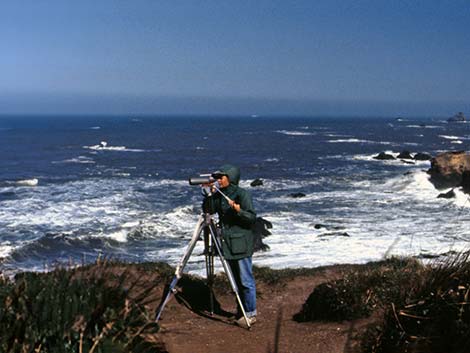 Birding Northern California headlands (Humboldt County, CA; ca. 1985) |
Little did we know it at the time, but minor experiences at Humboldt State would change our lives and set the direction for our future for years to come. We were birders -- everything we did revolved around birds -- my wildlife degree actually was a degree in "duck ranching." However, I was fascinated by two topics: statistics and evolution. I took all the stats classes I could; I even made money tutoring statistics. In my senior year, I had to take a field techniques class before I could graduate, so I decided to do a small mammal project because it might be my last chance to have access to a bunch of live traps. I caught mice in sand dune and forest habitats, measured their feet and tails, and used stats to look at the differences: beach mice had bigger hind feet (snowshoes for the sand?), and forest mice had longer tails (better balance climbing in the trees?). Little did I know that I was setting out on a path that I would follow for the rest of my life. |
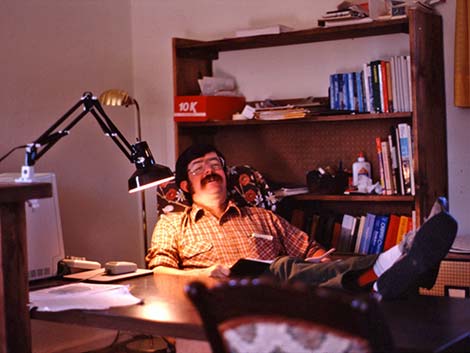 Asleep in my chair while studying hard at HSU Arcata, CA (1986) |
When we graduated in the fall of 1986, we accepted a pair of research positions out of the University of Georgia doing fieldwork on barrier islands (National Park Service areas) off the coast of Georgia and North Carolina. I was doing wildlife biology (small mammals and birds) and Liz was doing botany -- we thought life would be good. We should have realized, however, that there must have been a problem with the positions given that the University of Georgia has an entire School of Forest Resources, an Institute of Ecology, a Museum of Natural History, and myriad other sources of labor, but despite this, they had to go all the way to California to find workers. It turned out that nobody at the University of Georgia would work for our boss. |
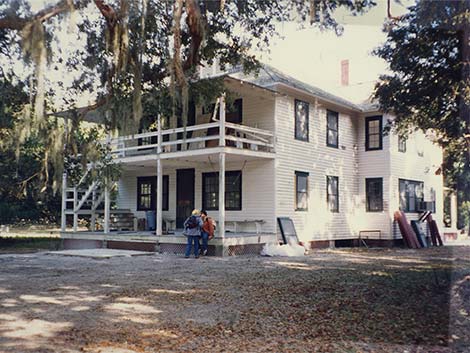 Home during a very long month of research Cumberland Island, GA (1987) |
We made the best of a difficult situation during the 9-month field season. We spent 5 weeks designing and starting up a wildlife monitoring project on Cumberland Island National Seashore. At one point, the park superintendent started asking me questions about the survey and in particular, where I was seeing ducks. It turns out he wanted to illegally poach my study subjects! Life on Cumberland Island was difficult. The living and working situation wasn't the best: they didn't even tell me that I needed to bring my own writing paper -- I had to use the back of some old forms for field notes. At first, they didn't even want us, a married couple, to sleep together because it might cause moral issues for other staff living in the bunkhouse. We had our own room, and I guess management got over it. They took us off the island for 2-3 hours per week to go grocery shopping. |
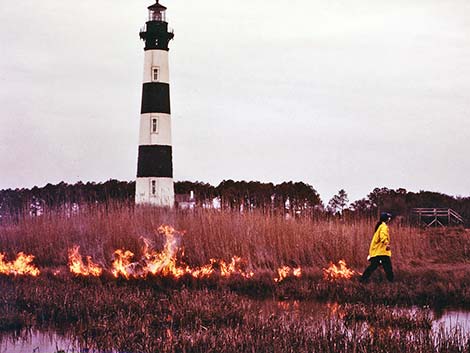 Fieldwork near the Bodie Island Lighthouse (Cape Hatteras, NC; 1987) |
After Cumberland, we moved north to Cape Hatteras National Seashore where we conducted vegetation experiments (e.g., burning study plots), monitored small mammal populations in relation to vegetation studies, and inventoried breeding bird populations. We were interested in controlling invasive plant species on the island and in the marshes. We did a lot of work trying different methods to eradicate common reed (Phragmites), including burning it down and covering the stumps with clear plastic to heat up the soil and cook the roots. |
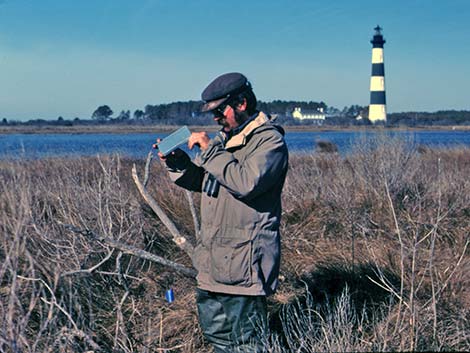 Checking a live trap on Bodie Island Cape Hatteras, NC (1987) |
We spent our free time exploring our new environment. We wandered the barrier islands and coastal marshes, fished the surf and sound, canoed hardwood swamps, goofed with alligators and snakes, and fought off zillions of mosquitoes, ticks, chiggers, and biting flies. When canoing, Liz delighted in catching biting flies and feeding them to the fish. Some of our best time-off time was spent with state biologists banding birds. We boated out to sand-spit islands, set up hardware-cloth corrals, and herded hundreds of fledgling terns into the corral (terns can run before they can fly). One by one, we banded and released the young birds. We also banded nestling brown pelicans just before they were ready to fledge. We caught the birds off the nest by getting close enough for them to bite us, then we grabbed their bill (hopefully) before they grabbed us (pelicans are full-sized before they leave the nest, so these were big babies). With parents bombing us from above with barf and poop, it was a stinky job. |
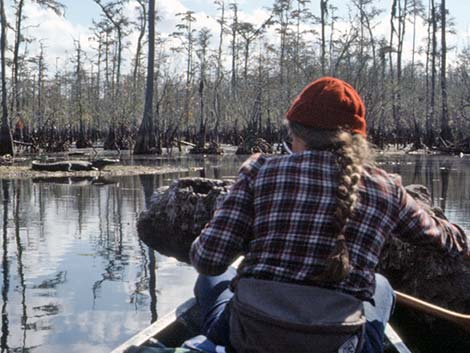 Liz in canoe; 10-ft alligator on river bank Okefenokee Swamp, GA (ca. 1990) |
After the field season, we got into grad school at the University of Georgia. Liz worked on campus in the biology labs doing high-tech genetic research on things like rice and the common cold. When I wasn't in class, I was out in the swamps chasing field mice (Cotton Mice, Peromyscus gossypinus). I spent many months in a lab with no windows or behind a computer working, but my research required spending a lot of time camping and wandering the swamps and mountains around the southeast in search of field mice. I enjoyed teaching upper division biology classes. My primary teaching responsibility was comparative anatomy, but I enjoyed teaching Mammalogy and Natural History of the Vertebrates. I also worked with my professors catching and studying shrews and salamanders in the mountains of Georgia and North Carolina. |
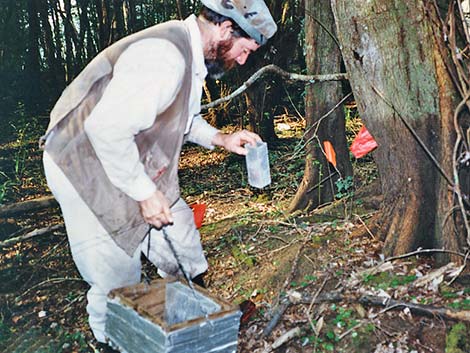 Using live traps to catch mice in a swamp Florida (ca. 1992) |
The southern hardwood swamp environment is like nothing in the west. For a Westerner, there was nothing in my background that prepared me for the swamps. Every day out in the woods was a new adventure -- the sights, the smells, the sounds, the humidity, grizzled old southern farmers, the cottonmouths -- all were new and exciting adventures. The humidity was intense. I would be out in the woods checking traps before sunrise, and it would already be so hot and humid that I was soaking wet within minutes of getting out of my truck. One old boy down on the Altamaha River made me his cousin after I led fire fighting efforts that saved his houseboat and perhaps several others from burning to the waterline. We lost one houseboat, but we saved the rest. |
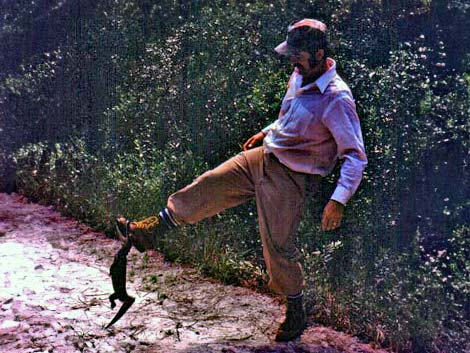 Hazards of working in the Okefenokee Swamp: a young alligator clamps onto my foot |
The South was interesting, but we were Westerners, and we longed for the West. Every time we got on the interstate driving west towards Atlanta, we dreamed about just continuing west. Eventually we graduated, pointed the trucks west, and headed home. As I was finishing my studies, we started applying for teaching jobs in the West. It turns out that there are lots of small universities with high turnover rates in the east, but few in the West, so I tried to stay in school longer hoping for a university job out West. About the time they were going to kick me out of school, I took an industry job on the Yucca Mountain Project in Las Vegas, Nevada. I had hoped to pass off this job as a short-term post-doc and move on to a university from there, but it never happened, and I accumulated a stack of rejection letters from western universities. We eventually changed directions again, deciding to stick with what we had and make the best of it ... and it turned out well in the end, but that is getting ahead of the story. |
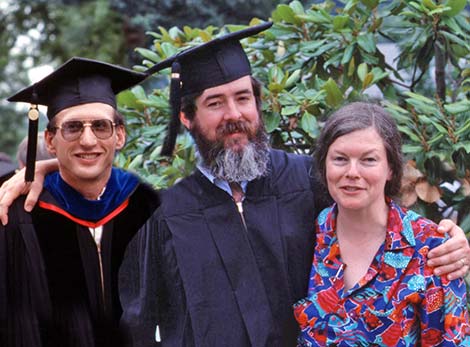 Best buddy and Liz on Graduation day: Ph.D. for Jerome, M.S. for me (University of Georgia; 1990) |
The Yucca Mountain Project was the huge U.S. Department of Energy project to take all of the spent nuclear fuel from power plants around the country, plus some other high-level radioactive waste, and bury it forever in the bottom of Yucca Mountain. I started as a Senior Scientist studying the environment before before any radioactive waste arrived to see what was there first. In the future, scientists would be able to compare the results of their studies with our results to see if anything changed. I was responsible for managing the small mammal and reptile (except desert tortoise) programs. My first two years on the Yucca Mountain Project were great, except that I had two bosses that didn't like each other, and I was often caught in the middle of their dysfunctional relationship. At least they agreed on disliking their boss, so we three always had something to agree on. Despite this, I enjoyed going out for a week at a time to work our study plots. The time I spent catching rodents (mostly kangaroo rats and pocket mice) and lizards (mostly side-blotched lizards) was priceless. |
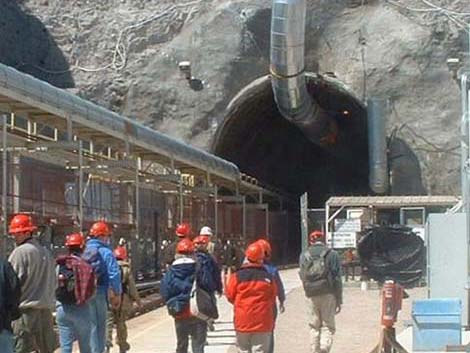 Walking into the belly of the beast Yucca Mountain, NV (ca. 2004) |
In my third year at Yucca Mountain, the budget ran into a political ripsaw, project funding was cut dramatically, and the Department of Energy decided that they didn't need any more environmental data. We laid off our 60-some field crew, and the Senior Scientists started analyzing data and writing up final reports. As each of us finished, we too were laid off. It didn't take long before my colleagues started slowing down, and it seemed to take forever to get their reports finished. I was fortunate because I had two major projects and therefore more reports to write than the others, but it only took a year to finish mine. When it was my turn to be laid off, one manager asked why I, the productive one, was getting the boot while the slackers were staying on. They decided to have me help the others finish their reports. This didn't go over well with my colleagues, but after another year, all of the reports were done. |
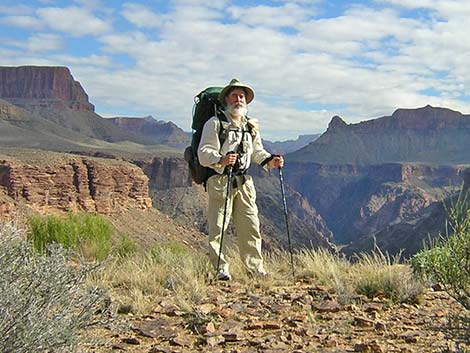 Getting back to who I am and where I want to be (day 8 of 10; solo in Grand Canyon, AZ; 2004) |
I continued applying for university jobs during those 4 years and doing other things to improve my chances of getting a university job. For example, Liz and I spent one day per week working as Research Associates at the Nevada State Museum cleaning up and organizing the mammal collection, and we tried to develop relationships with professors at the local university. As the years passed and the rejection letters piled up, it became apparent that we could continue spending a lot of time working and hoping for what we couldn't get, or we could sit back and enjoy the life we had. I was offered the chance to stay on the Yucca Mountain Project with my current salary if I would join the Technical Editing group and work with geologists and hydrologists with their reports. Helping other people write reports wasn't what I had dreamed of doing for my career, but we decided to take our lemons and make a big batch of lemonade. |
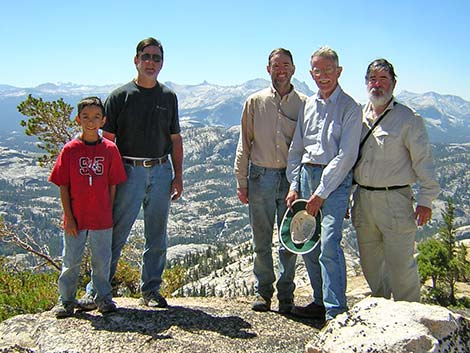 Carrying on and passing on -- three generations of backpackers (Yosemite, CA; 2004) |
I worked hard during those years and put in a lot of overtime, but I quit spending time doing things to get ahead, and started spending more time on the things I enjoy. We started hiking and camping more, and in 2001, I went on my first backpacking trip in more than a decade. In 2002, I went on two backpacking trips. I did 3 trips in 2003; 4 in 2004; 5 in 2005, 6 in 2006, and 7 in 2007, and 8 in 2008. Keeping this up was going to be real problem by 2025, but it fell apart in 2009 when I didn't do a single trip. Our lemonade turned out to be sweet, and in 2006, I gave up my well-paying editing job for a low-paying field job counting plants for the U.S. Geological Survey and living in the bush. I had done my time in Purgatory; it was time to be free. The USGS adventure didn't turn out so well (I refused to falsify data), but it led to even bigger and better things when we started our own environmental consulting firm: Desert Wildlife Consultants, LLC. I was doing what I loved, but I was making more money than ever before. The more I thought about being free, the more I realized that Daniel Boone was still in my blood. |
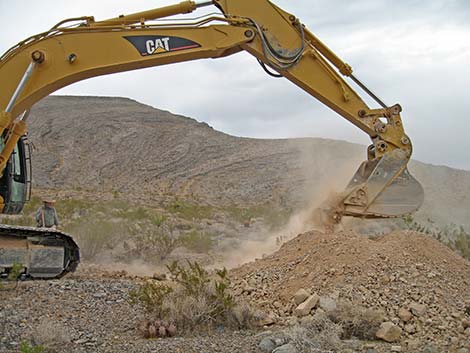 At work with Desert Wildlife Consultants, LLC (Mojave Desert, NV; 2007) |
Well, I turned 50 [a couple of years ago]. Often you hear about people engaging in some act of stamina or courage on the their 50th birthday just to prove that they still have what it takes. I thought about doing some memorable feat too, but I realized that I didn't need to prove anything to anyone, so I stayed home, relaxed in the air conditioning (105 degrees outside), and ate ice cream for lunch. I worked when there was work to be had, which in the economy of 2008-2010, wasn't too often. I was good with that because a few months of work left plenty of time out photographing feathered and furry friends in the mountains and deserts around Las Vegas. Given the opportunity, I'd head for a spring where I could sit quietly, contemplate the little delights in life, and photograph my friends as they come by for a drink or an evening bath. |
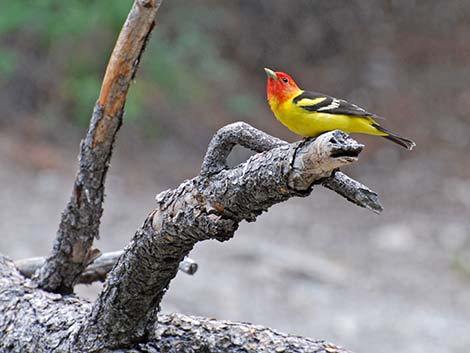 Spending quiet time with a feathered friend (Spring Mountains, NV; 2007) |
The rest of my time, I spent mostly hiking with Liz or friends, or working the website. Birdandhike.com gives me great delight. Liz thinks it is an obsession. I lived and worked in the desert on construction sites during most of 2010. The spring and fall were nice, but living outdoors in the middle of summer (high temperatures only to about 117 that year) was hard. It was also hard to be away from Liz so much, and it was hard missing the spring, summer, and fall hiking and camping seasons with friends and family. Mostly I felt that life with a young and healthy Liz was passing me by. When a job ended just before Thanksgiving 2010, I retired. Not worrying about getting called to work (e.g., with no prior warning: Can you be on a job site tomorrow morning?) freed us up to make travel plans coordinated with other people. |
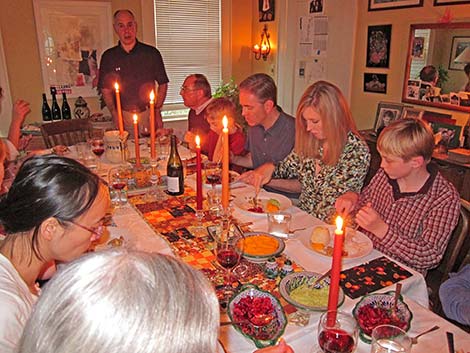 Doing what's important: Thanksgiving with family Austin, TX (2010) |
We visited my family in Texas for Thanksgiving, Liz's family in the mountains of Colorado during summer, backpacked with my brother and his kids in Oregon during summer, and I spent 3 weeks with family in Oregon. We even did some international travel (Galapagos Islands and Ecuador) for the first time since 1989. During the Texas trip, I made a near fatal mistake in the dim morning light when I caught a snake among the colorful leaves of fall along a coastal trail. It looked like a harmless long-nosed snake from home, but it turned out to be a Texas Coral Snake. After a 30 minute drive to a local hospital, a helicopter flight to a major hospital, a night in the hospital, a $50K-plus bill, and months of burning sensations in my finger, I am fine. The lesson learned: be extra careful playing with wildlife when not on your home turf. |
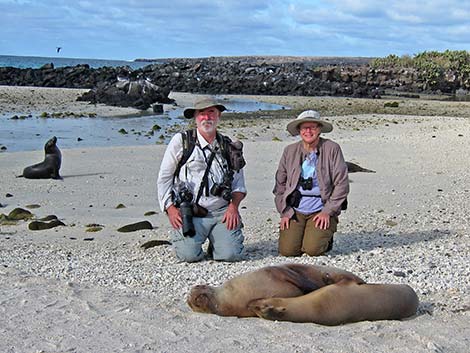 Galapagos sea lions on Isla Genovesa Galapagos Islands, Ecuador (2011) |
These days, I have some small writing and database contracts, but most of the work is done at home where Liz and I have dinner together every night. We get out when we want, and we even do outdoor volunteer work together. I did spend a week out in the desert on a species inventory project by myself (saw one other human), but it was my project, and it was wild and fun. Life is good. In 2011, we took the opportunity to join a group going to Mainland Ecuador and the Galapagos Islands (which are part of Ecuador). The trip was billed as birding and wildlife photography, but we didn't quite believe it until we got there. What an amazing place and a great group to people to visit it with. The hummingbirds and tanagers in the Andes were spectacular, and for an evolutionary biologist, it was the thrill of a lifetime to see and photograph Darwin's Finches in the flesh! |
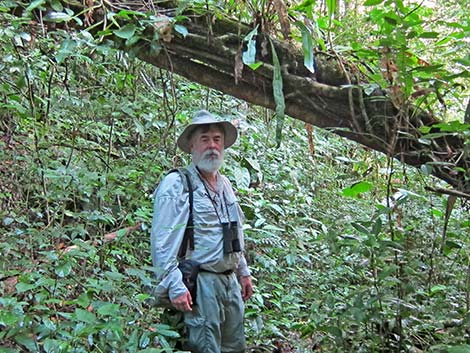 Birding the wet forest in Jamaica; January 2012 |
Going through a pile of junk email when we got home from Ecuador, we stumbled upon an alumni trip from Humboldt State University traveling to Jamaica with the stated goal of seeing all 28 endemic species of birds on the island. Again, a great trip with a great group of biologists and trip leaders. And yes, I did see all 28 species, plus crocodiles and other wild creatures! Smitten by the bug of international birding, more international trips are in the works. |
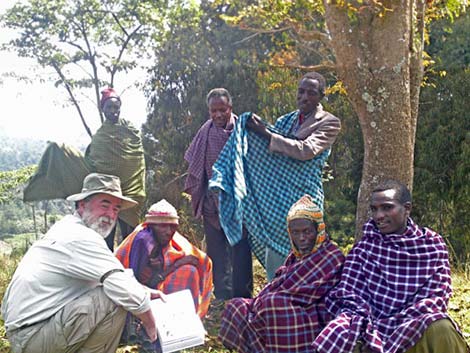 Birding rural areas with local men Mbulu, Tanzania (July 2012) |
My sister, a political science professor at UT Austin, works on African land policy issues and has traveled to Sub-Saharan Africa many times over the past 30 years. In 2012, Cathy was returning to Tanzania with one open seat in her vehicle and needed someone to act as gopher, body guard, gear guard, and familiar company, so after years of offering to tote her bags in Africa, I finally got the chance, but Liz said I couldn't catch any snakes. For Cathy, this trip was just another busy field season with too much to do in too little time. For me, it was the chance of a lifetime to visit a far-off part of the world that I never expected to see in person. You've got to love those research grants! I had the chance to bird with local guides, visit Tarangeri National Park on a day-safari to see lions, elephants, vast herds of zebra and wildebeest, and amazing birds. The best part of the trip was seeing all three species of plains vultures feeding on a recently dead zebra. |
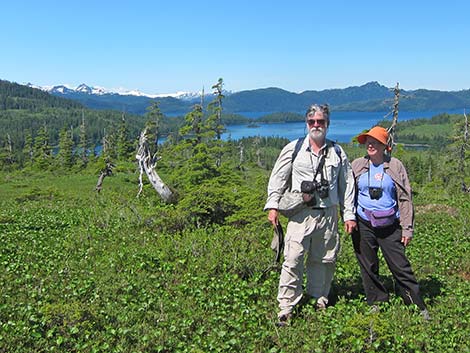 Birding Coastal Alaska (July 2013) |
Liz and I made much of 2013. Following the birds, we took a spring road-trip to the Lesser Prairie Chicken Festival in Oklahoma. We saw dancing Lesser Prairie-Chickens, Le Conte's Sparrows, and Black-capped Vireos in Oklahoma, Golden-cheeked Warblers in Texas, and a Crescent-chested Warbler in Arizona on the home. During summer, we beat the heat on a 6-week road-and-boat trip to visit friends and family in Oregon, Washington, and Alaska. We had a good time with the humans, saw some nice life birds (e.g., Fork-tailed Storm-Petrels, Ancient Murrelets, Kittlitz's Murrelets, Thick-billed Murre, and Aleutian Terns), and saw lots of Black-footed Albatross, Sooty Shearwaters, and Black-legged Kittiwakes. |
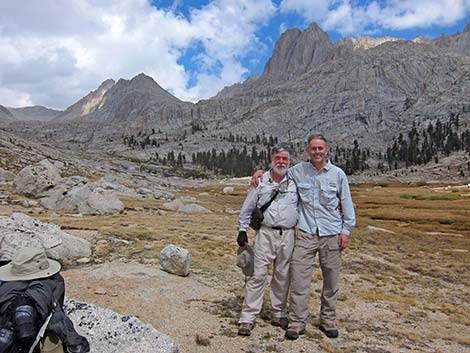 Miter Basin near Mt Whitney (Sept. 2013) |
In September 2013, my little brother and I spent 5 days backpacking in the Sierra Nevada Mountains of California in the area just south of Mt. Whitney. The hiking was fun, the high-elevation scenery was grand, and the photos of Alpine Chipmunks were surprisingly good. In the summer of 2014, Liz and I checked off a major bucket-list item. We drove from Las Vegas to Michigan, north into Canada, and then even farther north and east to Labrador and Newfoundland, and back for a total of 12,000 miles. It was a long drive, but we saw some amazing country (Labrador is really big and wild), met lots of interesting and welcoming people (the locals are interested in the outside, but you need to show some interest in them first), saw some cool mammals (plenty of bears, moose, red squirrels, and porcupine), and saw some fantastic birds. The highlights of the trip were visiting Red Bay in Labrador and breeding seabird colonies in Newfoundland. |
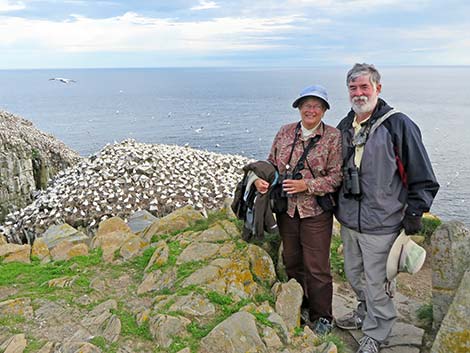 Bird Rock, Cape St. Marys, Newfoundland (2014) |
Red Bay is the site of a 1600s-era Portuguese whaling settlement, and we got to stay in a converted fish packing plant on the edge of the bay. Our window was over the water, and Common Loons and Arctic Terns fished in our "front yard." In Newfoundland, we visited a Viking settlement site (dating from about year 1000) in the north and seabird colonies in the south. There is a world-class Atlantic Puffin colony on offshore islands at Witless Bay Ecological Reserve and one of the biggest Northern Gannet colonies at Cape St. Mary's. We had been trying to get to those seabird colonies for 30 years, so it was great to finally see them. Back home, I experienced another kind of life-altering experience. In November while hiking alone in the Mount Wilson Wilderness Area in northwest Arizona, I took a tumble off a slick, water-polished granite ledge and fell some 30 feet to the bedrock below. I got pretty beat up, but I didn't break any bones and was lucky to be alive. I hobbled out and drove home, but recovering from this will keep me off the long trails from some time. |
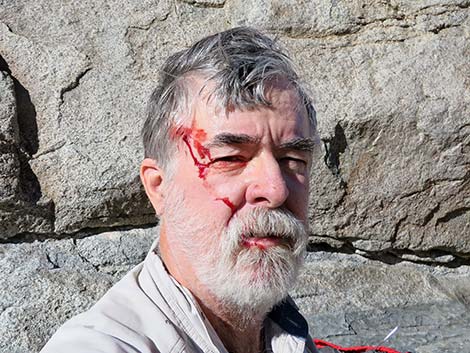 At the base of a 30-ft cliff -- lucky to be alive (2014) |
In the fall of 2014, still checking off bucket-list items, Liz and I got a super-cheap deal on a cruise from San Diego to Hawaii with 5 days at sea on the way over, 5 days on 4 islands, and 5 days back with a 1-day stop in Ensenada, Mexico. We had a relaxing time sailing over looking for birds on the open ocean, eating too much, and for me, spending time in the hot tubs soaking away aches and pains after the fall. On the islands, we participated in group tours, but we looked for birds as much as we could. We did see a couple of native forest bird species by skipping lunches and heading outside. The trip back across the ocean was even more relaxing until Ensenada, when we worked hard to find some Mexican bird species. |
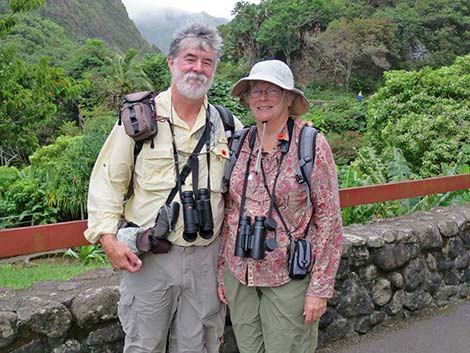 Birding the forests of Hawaii (2014) |
I've always enjoyed the outdoors and I've always loved the birds, and in 2015, the BLM called a meeting of local conservation organizations to ask us for help with taking down abandoned mining claim markers in Gold Butte National Monument. It turns out that these pipes, used by prospectors to mark the boundaries of their claims from about 1970-1990, inadvertently trap and kills cavity-nesting birds. It seems that these birds, looking for a nice nest hole, drop into the pipes and become trapped. They can't scratch their way out and they can't open their wings to fly, so they sit there until they die. The federal government outlawed these pipes in 2009, and Nevada passed a law giving prospectors 20 years to retrofit their markers. After the 20 years, citizens are empowered to remove the remaining upright pipes. I took on managing the Gold Butte project, and soon became the only person really working on it. It took a couple of years for us to clear out Gold Butte, and by then I was hooked on the project. |
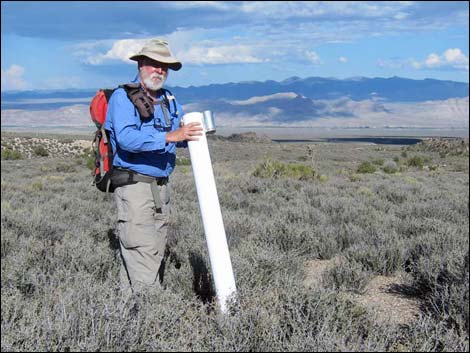 Knocking down an abandoned, bird-killing mining claim marker |
I've hiked so many trails and climbed so many peaks, that simply hiking doesn't satisfy me anymore. I find that hiking with this purpose, however, is infinitely fulfilling. These days (2024), I work in middle Nevada during summer, and then work in southern Nevada during winter when the lands up north are covered in snow. Up north, I mostly find birds in the pipes, but down south I mostly find native bees. Daniel Boone is in my blood ... or maybe not? Two of my dad's brothers have been doing a lot of genealogy work. It turns out that the family story, the one that tied an orphan Boone-boy to Daniel Boone, is not correct despite the notion that Daniel left a lot of little boone-lets in his wake as he traveled throughout the wilderness. The uncles believe that a poor Boone-boy fell in love with a rich girl, but her father would have nothing to do with it. To shed his poor ancestry, the Boone-boy declared himself an orphan. Free of embarrassing relatives, the father relented, and the rest is history. |
 |
Following this lineage, we are cousins of Daniel rather than descendants, but our lineage arrived in the new world in 1662-63, about 50 years before the Daniel Boone lineage did. Well, at least we got here first. It also seems our family might have migrated out to Scandinavia to Normandy, then to England, and finally to the United States, arriving in North America and first settling in Maryland. The story doesn't end here. I'll add more as things come up. Jim Boone -- Ecologist, Outdoors Man, and Environmental Activist. A westerner by birth, Jim has spent most of his life living in and exploring the southwestern deserts. Now retired, Jim shares his experiences on BirdandHike.com, a website that encourages people to get out in the deserts and mountains around Las Vegas, fall in love with our special places, and join the fight to protect public lands. |
Note: All distances, elevations, and other facts are approximate.
 ; Last updated 240223
| Glossary | Copyright, Conditions, Disclaimer | Home |